IT governance has become a growth question rather than merely an operational one. When strategy, applications and service delivery evolve independently, organisations lose coordination. This fragmentation reduces the value realised from digital investment.
This article explains how Digital Information Design (DID)1 can be used as an organising model to align Business Information Management (BIM), ASL and ITIL into one coherent management structure. Through this model, leadership teams can translate digital investment and delivery efforts into measurable mission-driven outcomes by combining lifecycle management, KPI/KRI-based steering and continuous improvement, supported by Lean and PDCA, with Scrum where appropriate.
[1] DID Foundation (no date) – DID: Digital Information Design
Index
- Executive summary
- 1) Fragmentation blocks growth
- 2) Governance design as structural remedy
- 3) Digital Information Design: structuring coherent information management
- 4) Embedding execution frameworks (ASL/ITIL/LEAN/Scrum)
- 5) Governing growth through measurement (KPI/KRI/PDCA/90-180-365/Scrum)
- 6) Three use cases
- 7) Board reflection
Executive summary
Digital transformation remains a strategic priority for many organisations. Yet evidence suggests that only a minority of initiatives fully realise their intended objectives.2 The constraint is seldom technology alone. More often, it is digital governance fragmentation: strategy, execution, and operational control evolve without structural coherence.
This article examines how deliberate governance design reconnects strategy, delivery, and measurable value through a coherent management and operating model. It uses the Digital Information Design (DID) model as the design layer, with ASL and ITIL positioned as execution anchors, Lean as the flow and waste-reduction discipline, and PDCA as the management rhythm for continual improvement. Scrum is applied where iterative learning is required, not as a universal guidance method.
The objective is not to introduce more frameworks, but to organise existing ones into a coherent operating model
The central leadership question is straightforward: is information governed as a strategic asset, or merely operated as infrastructure? The answer determines whether digital investment drives mission progress or mainly sustains activity.
Executive relevance
For senior management, CEOs and board members, a fragmented IT operating model is not a technology issue; it is an enterprise risk. When information assets are governed incoherently, strategic execution slows, capital allocation becomes opaque, risk exposure increases, and innovation returns diminish. Structural design determines whether digital investment accelerates mission delivery or dissolves into operational overhead. The real question is not whether frameworks are used, but whether integration and coherence have been deliberately designed.
[2] Boston Consulting Group (Oct 29, 2020) – Flipping the Odds of Digital Transformation Success
1) Fragmentation blocks growth
Where digital work is transferred across multiple organisational handoffs without shared flow controls, delay, rework and decision friction increase. This is why Lean-oriented3 value stream practices4 focus on waiting time, dependencies, excess work in process and non-value-adding activity.
Three board-level risks follow:
- Without portfolio visibility, application sprawl emerges5,6
- Without lifecycle governance, technical debt accumulates
- Without KPI/KRI discipline, executive steering becomes a management illusion5
Financial perspective
Fragmentation has direct financial consequences. Application sprawl inflates maintenance overhead. Unmanaged lifecycle decisions increase long-term remediation and run costs. Poor portfolio visibility distorts capital allocation.6 When cost-to-serve is not transparently linked to value, it risks shifting IT from a strategic investment vehicle to uncontrollable overhead. Organisations that do not explicitly design governance coherence will default to fragmentation.5,6
[3] Lean Enterprise Institute (no date) – What is Lean?
[4] ASQ (no date) – Value Stream Mapping
[5] ISACA Journal (Jul 1, 2018) – Integrating KRIs and KPIs for Effective Technology Risk Management
[6] OECD (2015) – G20/OECD Principles of Corporate Governance – Principle VI: Performance monitoring and oversight
2) Governance design as structural remedy
Digital Information Design (DID) is most useful when treated as a governance design model, not as another operational method. The DID Foundation positions DID as the successor direction of BiSL guidance, building on BiSL Next7 for Business Information Management (BIM). Used well, DID helps leaders structure recurring BIM activities and decision patterns before execution starts. The objective is not to introduce more frameworks, but to organise existing ones into a coherent operating model.
It brings practical value:
- Stronger control over sensitive and mission-critical information assets
- Lower cost caused by poor information quality
- A culture that prioritises quality, integrity and availability of information assets
The DID model belongs to a family of BIM models that aim to align organisational strategy, information structures and digital execution. Examples include BiSL for demand-side information management and enterprise governance models such as COBIT. DID focuses specifically on the design of coherent information structures across organisational domains.
In many organisations information is still managed as an operational by-product of applications, rather than as a strategic asset governed at enterprise level. DID shifts the conversation from “How do we manage IT?” to “How do we govern information as a strategic asset?”. It provides a structural way to align strategy, information design and operational execution.
[7] DID Foundation, in Dutch (Dec 6, 2022) – Wat is BiSL Next?
3) Digital Information Design: structuring coherent information management
DID can be understood as an organising model within the broader field of BIM. BIM frameworks aim to align organisational strategy, structures and execution so that information services contribute to measurable organisational outcomes. BiSL, for example, focuses on the demand side of information management, defining how business requirements for information services are organised and managed.
Within this landscape, DID focuses on the design of coherent information structures across organisational domains. Rather than introducing another operational framework, DID provides a structural perspective that helps organisations position existing frameworks in relation to each other.
The real question is not whether frameworks are used, but whether integration and coherence have been deliberately designed
To avoid conceptual dilution, the DID vocabulary must remain consistent. Its power lies in the explicit separation between domains, drivers and perspectives. This separation keeps management discussions structurally aligned with mission intent.
The DID model structures information management through three interconnected elements: operating domains, business drivers and architecture perspectives.
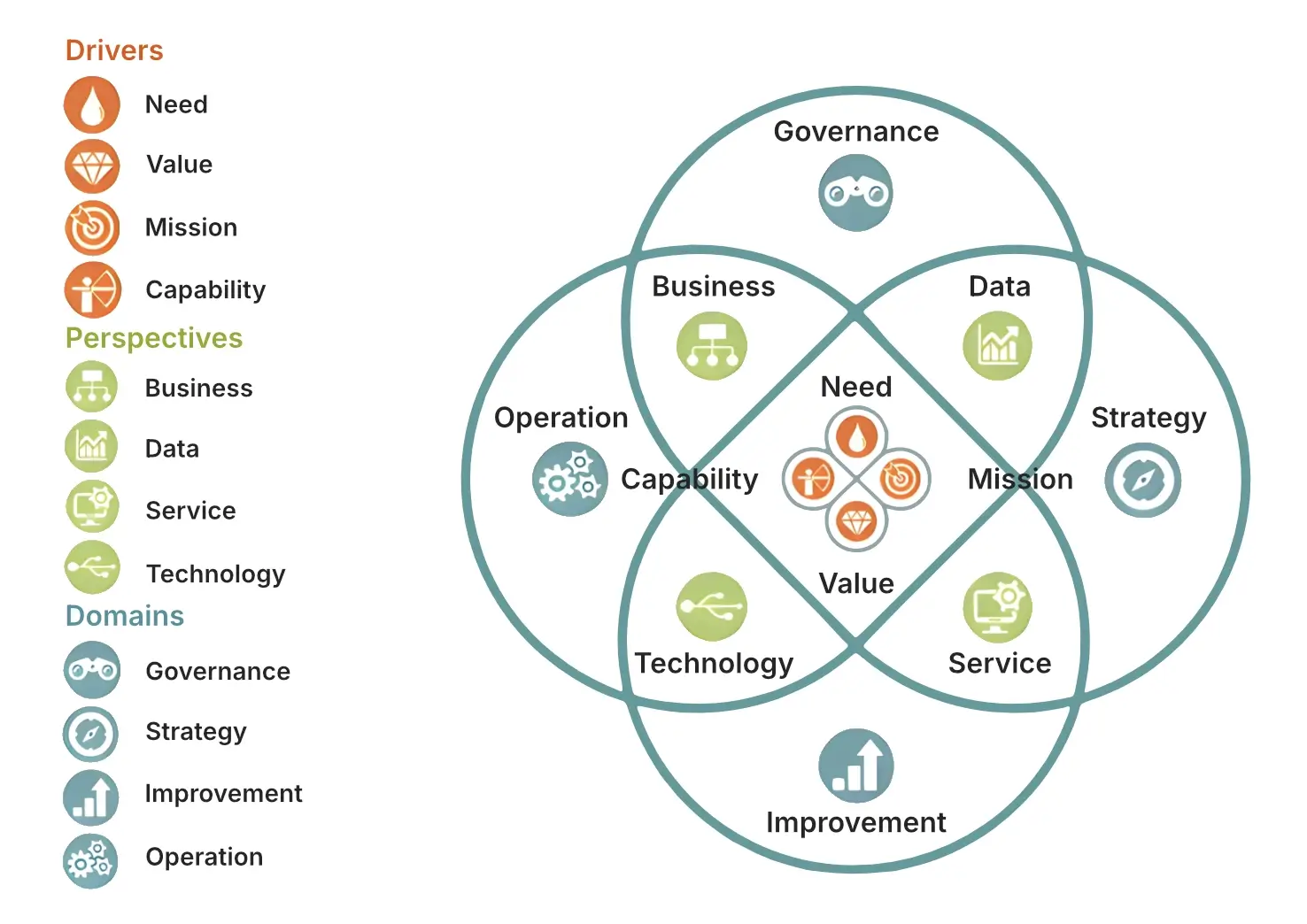
In practice, DID helps organisations position frameworks such as ASL, ITIL, Lean and Scrum within a coherent information management and operating model. More details about this you find in the next chapter.
Operating domains
- Governance: Defines policy intent, accountability, risk boundaries, assurance criteria, and decision rights to ensure information assets serve the mission.
- Strategy: Translates mission and value intent into portfolio direction, investment choices, and prioritised change initiatives.
- Improvement: Designs and tests change hypotheses, evaluates outcomes, and feeds structured learning back into Strategy and Governance. Scrum is an optional delivery method used where iterative learning is required.
- Operation: Ensures stable, secure and cost-effective delivery of live services and applications in line with agreed performance standards. It feeds Improvement, which in turn feeds Strategy and Governance (PDCA logic).
Business drivers
These shape and align all four operating domains and architecture perspectives.
- Need: The underlying problem, demand or opportunity that justifies intervention or change.
- Value: The measurable benefit expected from an information, service or application investment.
- Mission: The organisation’s purpose and long-term strategic intent that guide management choices.
- Capability: The organisational ability – people, processes and systems – required to deliver and sustain value.
Architecture perspectives
- Business: How processes, roles, management structures, and operating models create value.
- Data: How information is structured, governed, protected, and maintained to ensure integrity, quality, and usability.
- Service: How capabilities are delivered and experienced through service models, performance commitments, and user outcomes.
- Technology: The platforms, integration patterns, infrastructure, and tooling that enable reliable, changable and scalable operation of applications, data, and services.
Integration logic
This creates a continuous management loop aligned with PDCA thinking.
The business drivers (Need, Value, Mission, Capability) shape and test priorities across all operating domains and architecture perspectives, ensuring management discussions remain anchored in organisational intent rather than technical solutions alone.
The operating domains are mutually reinforcing rather than linear: Operation produces performance evidence, Improvement converts evidence into change, and Governance and Strategy adjust direction and investment decisions.
The architecture perspectives ensure structural coherence across the organisation: Business frames how value is created and measured, Data ensures information integrity and usability, Service structures how capabilities are delivered, and Technology enables reliable, adaptable operation of applications and platforms.
Together these elements create a coherent information management structure in which strategy, lifecycle management and service delivery continuously reinforce each other.
4) Embedding execution frameworks (ASL/ITIL/LEAN/Scrum)
Within DID, ASL and ITIL act as execution anchors, while Lean and Scrum provide delivery discipline within that governance structure. Lean focuses on improving flow and reducing waste across processes, helping organisations identify bottlenecks in service delivery and application lifecycle management. Scrum complements this by organising development work into short iterations, enabling teams to deliver improvements incrementally while maintaining alignment with portfolio priorities. In this context Lean improves operational flow, while Scrum structures iterative product delivery.
- ASL structures lifecycle decisions. It supports disciplined choices to maintain, modernise, consolidate, or retire applications.8 Where relevant, lifecycle management is also a financial discipline: these choices influence depreciation profiles, cloud consumption patterns, and long-term operating cost structures.
- ITIL structures service management and reliability. It provides practices for service value, reliability, and continual improvement across live operations.9
- Lean guides flow and waste reduction. It contributes value-stream thinking, disciplined operational flow, and continuous improvement to prevent mere local optimisation and improve end-to-end value delivery.10
- Scrum guides adaptive team execution, not governance. It is applied where uncertainty is high and iterative learning is required; the Scrum Guide11 defines Scrum as an iterative, incremental framework for adaptive solutions to complex problems.
[8] DID Foundation (no date) – ASL
[9] ITSM tools (Jan 6, 2026) – ITIL 4 Explained: Framework, Practices, and Key Changes
[10] ASQ (no date) – Value Stream Mapping
[11] Scrum Guides, Schwaber, K., & Sutherland, J. (PDF Nov, 2020) – The Scrum Guide
5) Governing growth through measurement (KPI/KRI/PDCA/90-180-365/Scrum)
The visual below shows how DID domains and drivers operate in a measurable BIM context.
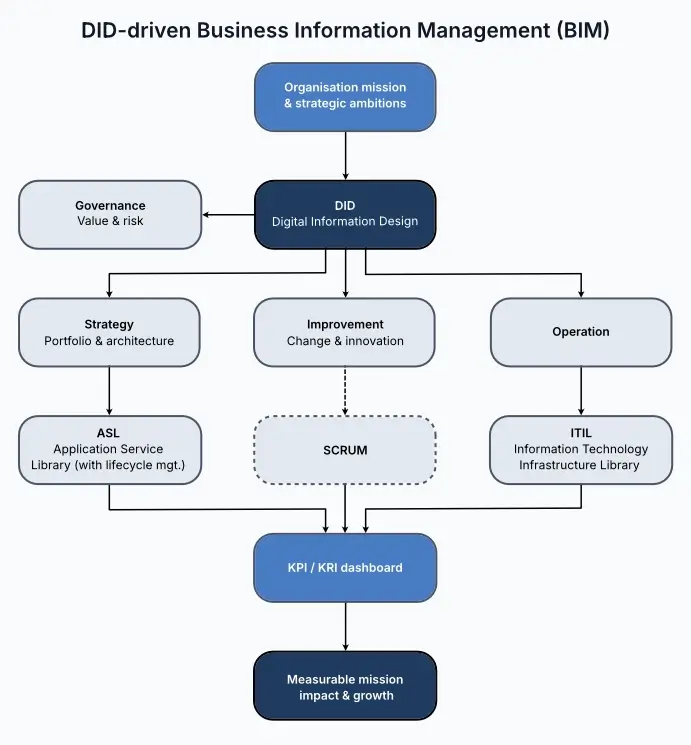
Why KPI/KRI + 90-180-365 + PDCA + Scrum is a valid structure
This structure is valid because each element addresses different needs:
- KPI/KRI: Using the right metrics provides an objective view of organisational performance and risk. KPIs track performance outcomes, while KRIs track risk exposure. Managing one without the other distorts decisions.12
- 90-180-365 cadence: This is a practical governance cadence, not a DID standard. Ninety days aligns with quarterly steering rhythms, 180 days enables two learning loops, and 365 days supports annual portfolio rebalancing.13
- PDCA across DID domains: PDCA is not merely a method inside DID; it functions as the management rhythm that orchestrates continual improvement across domains. This iterative framework provides an evidence-based approach to managing change, ensuring decisions are validated before scaling.14
- Scrum where applicable: Scrum is used where adaptive, incremental delivery is needed; it is not required for all work types.
None of these frameworks resolve fragmentation unless embedded in a coherent governance design.
PDCA animates DID
The PDCA cycle does not replace DID; it animates it. This is what it comprises:
- P – Plan: Set objectives for the system and processes to deliver results (“what to do” and “how to do it”).
- D – Do: Implement and control what was planned.
- C – Check: Monitor and measure processes and results against policies, objectives, requirements, and report results.
- A – Act: Take actions to improve process performance.
[12] ISACA Journal (Jul 1, 2018) – Integrating KRIs and KPIs for Effective Technology Risk Management
[13] OECD (2015) – G20/OECD Principles of Corporate Governance – Principle VI: Performance monitoring and oversight
[14] ISO (PDF 2015) – The process approach in ISO 9001:2015
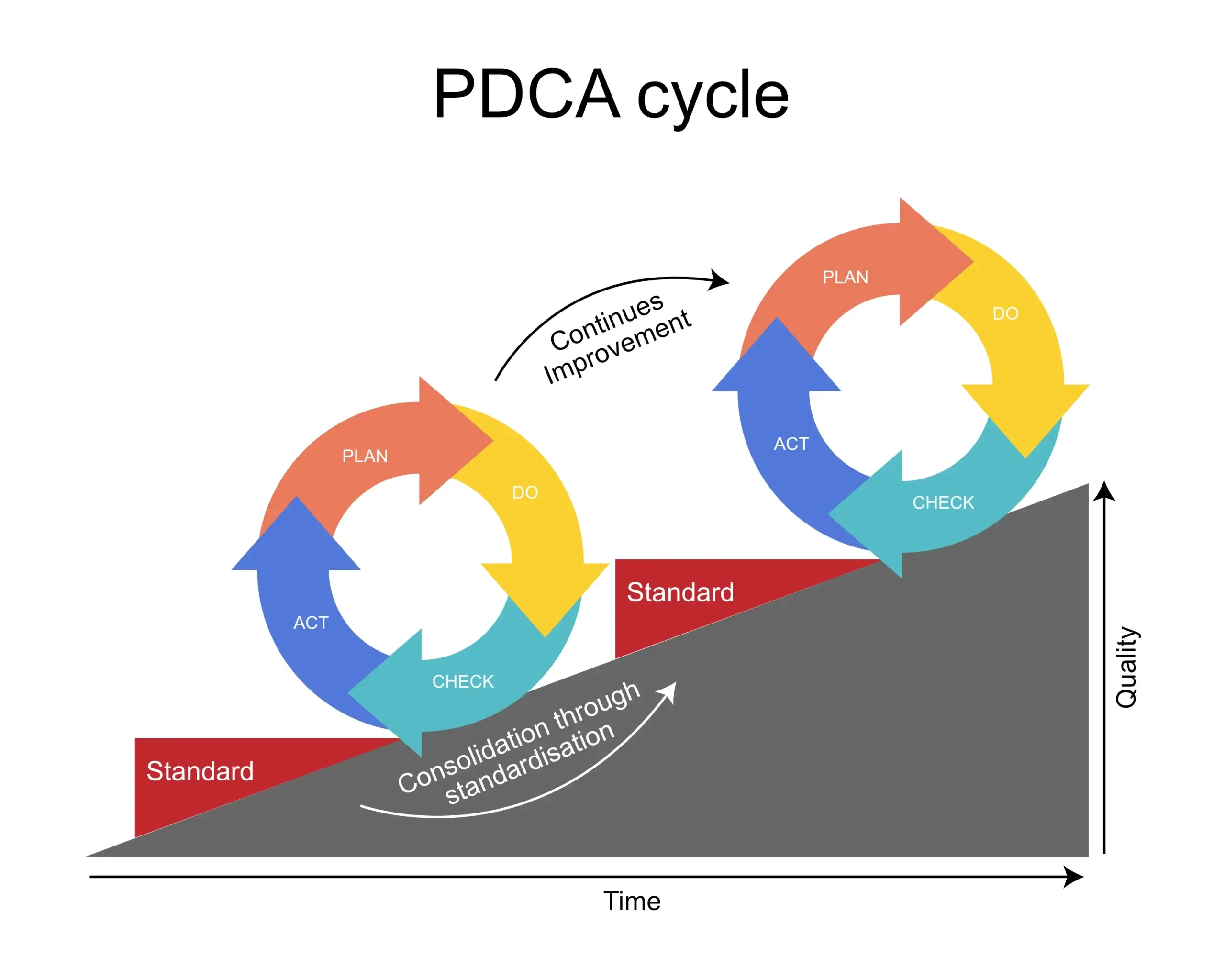
Applied within the DID operating domains:
- Governance (Plan/Check): Set policy intent, controls, and conformance checks.
- Strategy (Plan/Do): Translate mission and value into portfolio and funding decisions.
- Improvement (Do/Check): Test change hypotheses, evaluate impact, feed learning back.
- Operation (Check/Act): Monitor service and application performance, then standardise corrective actions.
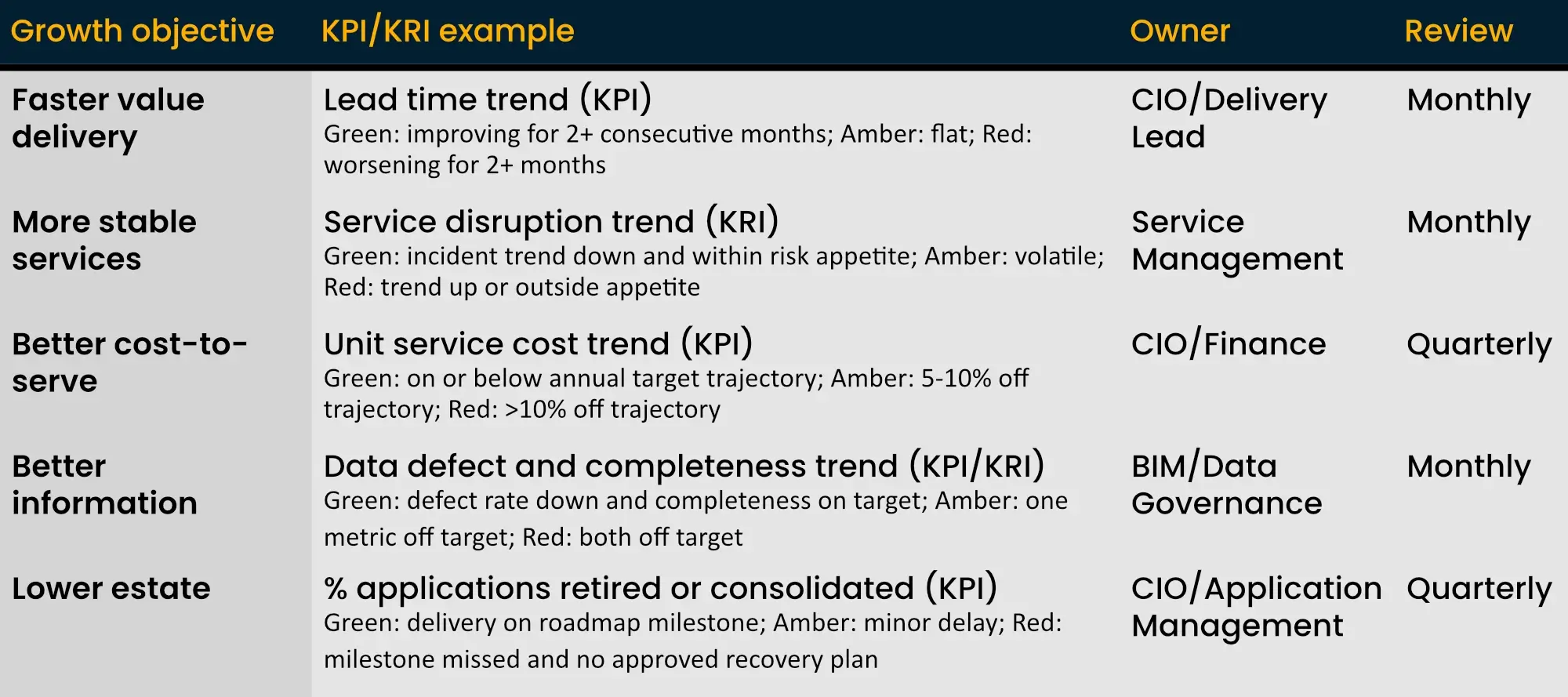
KPI/KRI-coupled growth model
Financial coherence emerges when lifecycle decisions, service performance and capital allocation are reviewed in the same governance cadence. Separating operational KPIs from financial steering reproduces fragmentation at board level.
6) Three use cases
The following examples show that lifecycle governance and flow discipline produce measurable operational and financial outcomes.
Case 1: Application rationalisation local authorities UK15
A collaboration between several UK local authorities, including Hounslow and Chesterfield, faced fragmented consultation processing across planning teams. Responses to public consultations were manually tagged and categorised in different ways by different teams, leading to inconsistent execution, duplicated effort and long processing times. Because workflows and information structures were not aligned, the cycle time for analysing consultation responses varied significantly between teams, reducing confidence in decision speed and transparency.
The intervention focused on rationalising the application landscape and standardising information flows. Shared data structures and a unified workflow were introduced, supported by digital tooling that automated classification and tagging of consultation responses. Delivery was organised iteratively, allowing teams to test and refine the process while aligning improvements with broader portfolio priorities.
The pilot demonstrated measurable operational gains. Officer time spent processing consultation responses was reduced by approximately 45%, significantly improving consistency and enabling planning teams to focus on higher-value analytical work rather than manual processing.
Case 2: Platform architecture and data-driven operations bol.com16
A well-known example from the Dutch private sector is bol.com, one of the largest e-commerce platforms in the Netherlands and Belgium. The organisation operates a digital platform that connects millions of customers with thousands of retail partners, requiring a scalable architecture and disciplined operational processes.
To support this scale, bol.com built its platform around an event-driven architecture in which systems respond to business events in real time. This approach allows operational processes and digital services to react quickly to changes in demand, while ensuring that decisions are based on current data rather than delayed reporting.
The platform also relies on reusable automation and shared services. By defining operational processes once and reusing them across the platform, bol.com reduces duplication, improves consistency and enables teams to scale services without increasing operational complexity. From an organisational perspective, multidisciplinary teams work continuously to improve the platform, combining service development, operational monitoring and data analysis. This model illustrates how a coherent service architecture and disciplined lifecycle management can translate digital capability into reliable operations and scalable platform growth.
Case 3: Lifecycle integration in high-tech manufacturing at ASML17
A well-known example from the Dutch private sector is ASML, the semiconductor equipment manufacturer whose products require the integration of extremely complex hardware, software and data systems. Managing this complexity requires strong lifecycle coordination across engineering, manufacturing and service operations.
To support this, ASML uses integrated digital lifecycle management tools that connect product design, engineering data and production planning. These systems allow engineers to simulate production scenarios and evaluate design changes early in the development process, reducing rework and improving coordination between development and manufacturing teams.
By managing engineering information, product design and manufacturing processes within one integrated digital environment, ASML improves the reliability and scalability of its innovation process. The approach illustrates how disciplined lifecycle management and shared architecture principles can support the development and delivery of highly complex technological systems.
From a Digital Information Design perspective, this reflects the alignment of business processes, data structures, services and technology within one coherent lifecycle environment, enabling innovation without losing operational control.
7) Board reflection
Before approving the next transformation wave, leadership teams should ask:
- Are we funding mission outcomes or legacy project scope?
- Are we reducing application complexity or silently scaling technical debt?
- Are our dashboards proving value creation or merely reporting activity?
- Do ASL and ITIL execute DID priorities, or operate as disconnected initiatives?
An effective IT service organisation is not created by adding more frameworks, but by one coherent design in which information, applications, and services jointly deliver mission-driven growth.
[15] UK government (Dec 19, 2025) – Hounslow and Chesterfield cut response processing time by 45%
[16] Redwood Software (no date) – Retailer improves customer service and automates supply chain processes
[17] Siemens Digital Industries Software (no date) – ASML case study: Digital manufacturing tools support a world leader in a growing market